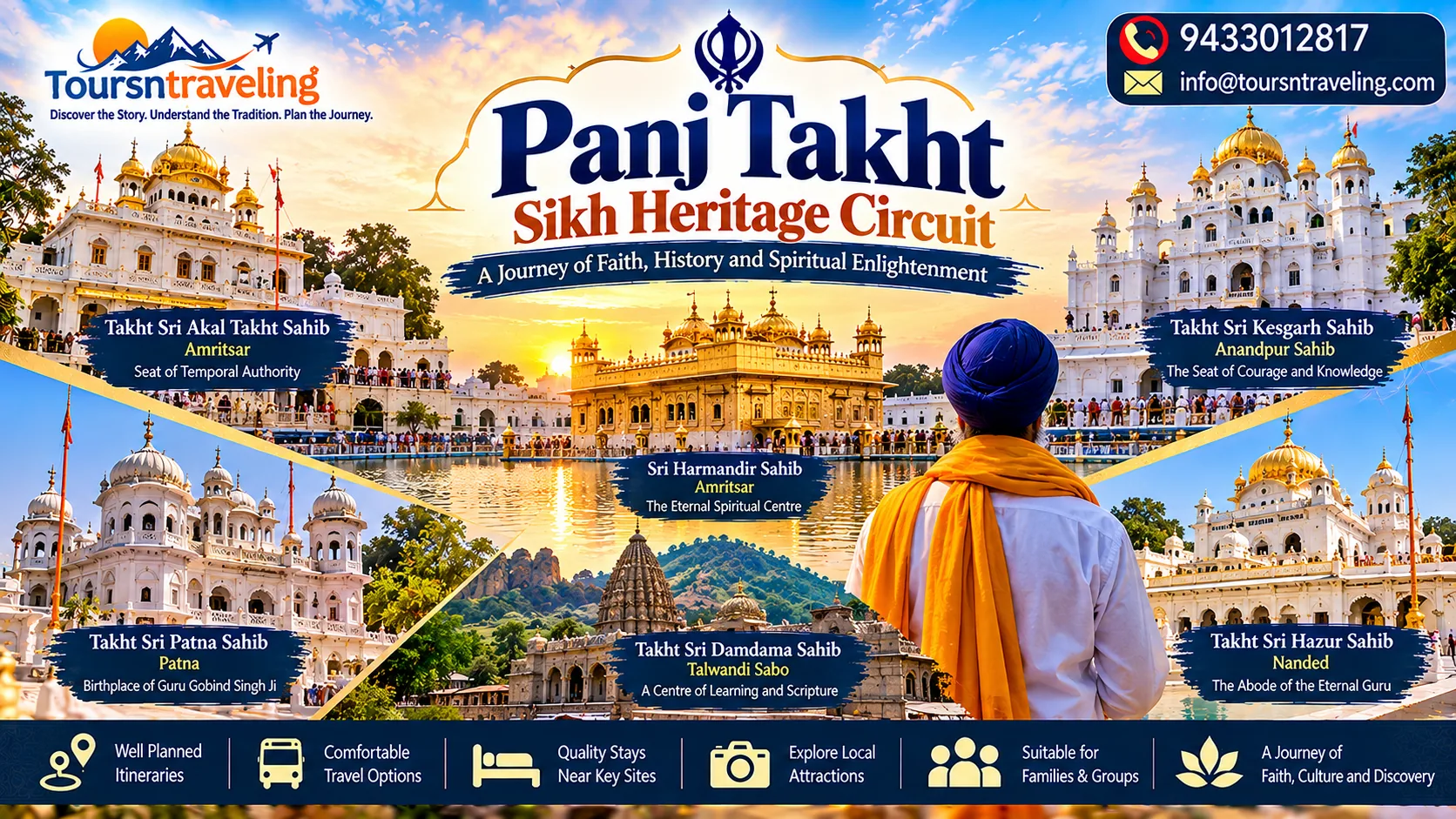
Five Takhts, Sikh history and living seva. Detailed day-wise visits, spiritual stories, local heritage, three hotel standards and a transparent budget framework.
Branded thematic illustration — confirm actual site appearance and entry procedures before travel
Five Takhts, Sikh history and living seva. This is a proposed land itinerary commencing from Amritsar, intended as a realistic conversation starter for a date-specific family or group quotation.
Planning-only figures: prices are illustrative and unverified against hotels or operators. Major transfers, airfare, special darshan, permits, guide fees, paid rituals and seasonal surcharges are excluded unless a dated quotation states otherwise.
Why this journey matters
The Panj Takht are the five seats of temporal-spiritual authority in Sikh tradition, spread across Amritsar, Anandpur Sahib, Talwandi Sabo, Patna and Nanded. The long-distance itinerary is a heritage pilgrimage, not merely five photo stops.
Standard
₹38,900
indicative per adult, 2 sharing • no confirmed inventory
Economy / clean local hotel
Budget road vehicle allocation
Final property and inclusion list in written quotation
Visit order is intentionally practical. Sacred narratives are marked as religious traditions; documented heritage is discussed separately. No temple access, ceremony or special queue is guaranteed.
Day 1 — Arrive at Amritsar
Visit Sri Akal Takht and Sri Harmandir Sahib according to access; explain the meaning of the Takht and the tradition of langar and seva.
Why this day matters: Open with a clear explanation of what a Takht means in Sikh tradition and identify the five locations on the actual route. An ambitious cross-country circuit needs careful transport planning from the first day.
Overnight: As stated in the itinerary For this route: Explain head covering, shoe removal and respectful conduct. Allow meaningful time around the complex rather than scheduling only a rapid photograph stop.
Day 2 — Amritsar to Anandpur Sahib
Travel to Sri Keshgarh Sahib; discuss the founding of the Khalsa in 1699 in Sikh historical tradition.
Why this day matters: In Amritsar, place the Akal Takht within the broader Harmandir Sahib setting and discuss seva and institutional history. Allow time for appropriate conduct, including head covering and shoe arrangements.
Overnight: As stated in the itinerary For this route: Do not treat these sites as interchangeable gurudwaras. A knowledgeable interpreter should describe the specific events and textual history associated with each.
Day 3 — Anandpur to Talwandi Sabo
Drive toward Takht Sri Damdama Sahib, allowing a full transfer day.
Why this day matters: At Anandpur Sahib, explain the formation of the Khalsa and why Kesgarh Sahib occupies a distinct place in Sikh memory. Avoid reducing the visit to a photograph of another gurudwara.
Overnight: As stated in the itinerary For this route: Do not treat these sites as interchangeable gurudwaras. A knowledgeable interpreter should describe the specific events and textual history associated with each.
Day 4 — Damdama Sahib heritage
Explore the Takht respectfully, including the association with Sikh scriptural scholarship; plan onward long-distance travel.
Why this day matters: At Damdama Sahib, discuss the specific associations with Guru Gobind Singh and Sikh scriptural tradition. The route should respect prayer times and the practical needs of pilgrims travelling between major regions.
Overnight: As stated in the itinerary For this route: Do not treat these sites as interchangeable gurudwaras. A knowledgeable interpreter should describe the specific events and textual history associated with each.
Day 5 — Travel to Patna
Air or rail transfer via a feasible gateway; arrival and rest. Actual sectors must be confirmed in a supplier itinerary.
Why this day matters: On the transfer toward eastern India, give priority to confirmed rail or air connections over optional detours. An extensive tour has multiple distinct geography and logistics chapters.
Overnight: As stated in the itinerary For this route: Verify lodging and intercity connections before promising a fixed nine-day completion. Temple access and security rules should be checked directly at each complex.
Day 6 — Takht Sri Patna Sahib
Visit the birthplace-related shrine associated with Guru Gobind Singh and learn about the heritage of Sikh communities in Bihar.
Why this day matters: At Patna Sahib, explain Guru Gobind Singh’s birth associations and the historical development of the institution. Visitors should know that rules may differ by complex and event.
Overnight: As stated in the itinerary For this route: Verify lodging and intercity connections before promising a fixed nine-day completion. Temple access and security rules should be checked directly at each complex.
Day 7 — Transfer to Nanded
Air/rail connection via an available hub; allow buffers and do not promise same-day connections without tickets.
Why this day matters: When continuing toward Nanded, allow suitable rest and travel buffers. A nine-day itinerary should not imply uninterrupted sightseeing across very long interregional transfers.
Stay: Nanded. Daily planning: Keep time for queues, rest, meals and local travel; final order depends on conditions.
Day 8 — Takht Sri Hazur Sahib
Visit Hazur Sahib and reflect on Guru Gobind Singh’s final years and the transmission of Guru Granth Sahib authority.
Why this day matters: At Hazur Sahib, present the final-life associations of Guru Gobind Singh in the appropriate historical context. Leave adequate space for respectful worship rather than immediately scheduling another attraction.
Overnight: As stated in the itinerary For this route: Verify lodging and intercity connections before promising a fixed nine-day completion. Temple access and security rules should be checked directly at each complex.
Day 9 — Departure
Depart via an available air or rail connection; additional night may be required based on schedules.
Why this day matters: Conclude with the agreed gateway transfer and a clear statement of which Takhts were visited. Travellers should receive a precise record of inclusions and alternatives for any weather or service disruption.
Stay: Departure. Daily planning: Keep time for queues, rest, meals and local travel; final order depends on conditions.
Pilgrim Knowledge Desk
The destinations in depth: sacred narratives, documented heritage and practical visits
A carefully interpreted pilgrimage should help visitors distinguish a sacred account from a documented historical event, and a customary ritual from a confirmed service. The following destination briefings connect the particular places on this itinerary with the questions a traveller should ask before departure. Temple rules, festival calendars and local access change; obtain current instructions from the relevant shrine or monument authority.
01 · Understanding the Panj Takht
Discover the Story · Understand the Tradition
The five Takhts are important seats of authority in Sikh tradition: Akal Takht, Takht Sri Kesgarh Sahib, Takht Sri Damdama Sahib, Takht Sri Patna Sahib and Takht Sri Hazur Sahib. Their significance is institutional and historical as well as devotional, and a serious tour should explain each individually.
Plan the Journey — what visitors need to know
Before publication, verify that the driving and rail/air transfers actually accommodate all five sites. The journey spans several states and should not be treated as one continuous short road excursion.
02 · Amritsar and the Akal Takht
Discover the Story · Understand the Tradition
The Akal Takht is closely associated with Guru Hargobind and the historical articulation of Sikh temporal and spiritual responsibility. Its setting adjacent to the Harmandir Sahib makes it integral to a wider discussion of Sikh institutions, seva and community.
Plan the Journey — what visitors need to know
Explain head covering, shoe removal and respectful conduct. Allow meaningful time around the complex rather than scheduling only a rapid photograph stop.
03 · Anandpur Sahib and Damdama Sahib
Discover the Story · Understand the Tradition
Takht Sri Kesgarh Sahib at Anandpur Sahib is associated with the formation of the Khalsa in 1699. Damdama Sahib at Talwandi Sabo has its own important historical associations with Guru Gobind Singh and Sikh scriptural tradition.
Plan the Journey — what visitors need to know
Do not treat these sites as interchangeable gurudwaras. A knowledgeable interpreter should describe the specific events and textual history associated with each.
04 · Patna Sahib and Hazur Sahib
Discover the Story · Understand the Tradition
Takht Sri Patna Sahib is associated with the birthplace of Guru Gobind Singh. Takht Sri Hazur Sahib in Nanded is linked with the final period of his life and has different cultural and ritual contexts.
Plan the Journey — what visitors need to know
Verify lodging and intercity connections before promising a fixed nine-day completion. Temple access and security rules should be checked directly at each complex.
Sacred tradition, historical heritage and temple procedures
Discover the Story
The Panj Takht are the five seats of temporal-spiritual authority in Sikh tradition, spread across Amritsar, Anandpur Sahib, Talwandi Sabo, Patna and Nanded. The long-distance itinerary is a heritage pilgrimage, not merely five photo stops.
Local sacred narratives enrich the journey, but a traditional account should not be described as independently verified historical fact.
Understand the Tradition
Every gurdwara requires head covering and shoes removed, with respectful conduct. This multi-state route needs actual flight/rail planning; the price excludes intercity flights unless written quotation includes them.
Allow the guide to explain customary etiquette and the difference between permitted rituals, donations and unofficial claims of privileged access.
Phulkari embroidery and Punjabi juttis; Patna handicrafts; handloom fabrics in Maharashtra; prioritize genuine crafts over rushed retail visits.
Shopping is optional, with no compulsory retailer visit or commission-based detour. Ask sellers about provenance, handloom authenticity and payment terms.
Accommodation plan — Standard, Deluxe & Premium
These are hotel standards, not confirmed named properties. Small mountain towns and pilgrimage villages often cannot supply conventional four-star rooms; Premium there means the best suitable available local stay. Confirm hotel address, lift access, room type, heating, meal plan and cancellation terms before payment.
Night
Overnight base
Standard
Deluxe
Premium
1
Amritsar
Well-reviewed budget hotel / dharamshala where appropriate
3-star-equivalent or reputable mid-range
4-star-equivalent where available, otherwise best practical local option
2
Anandpur Sahib
Well-reviewed budget hotel / dharamshala where appropriate
3-star-equivalent or reputable mid-range
4-star-equivalent where available, otherwise best practical local option
3
Bathinda area
Well-reviewed budget hotel / dharamshala where appropriate
3-star-equivalent or reputable mid-range
4-star-equivalent where available, otherwise best practical local option
4
Transit
Well-reviewed budget hotel / dharamshala where appropriate
3-star-equivalent or reputable mid-range
4-star-equivalent where available, otherwise best practical local option
5
Patna
Well-reviewed budget hotel / dharamshala where appropriate
3-star-equivalent or reputable mid-range
4-star-equivalent where available, otherwise best practical local option
6
Patna
Well-reviewed budget hotel / dharamshala where appropriate
3-star-equivalent or reputable mid-range
4-star-equivalent where available, otherwise best practical local option
7
Nanded
Well-reviewed budget hotel / dharamshala where appropriate
3-star-equivalent or reputable mid-range
4-star-equivalent where available, otherwise best practical local option
8
Nanded
Well-reviewed budget hotel / dharamshala where appropriate
3-star-equivalent or reputable mid-range
4-star-equivalent where available, otherwise best practical local option
Per-person indicative cost analysis (₹)
Planning component
Standard
Deluxe
Premium
Accommodation
₹12,400
₹19,800
₹32,800
Ground travel allocation
₹13,200
₹18,100
₹25,400
Meals & local visits
₹6,200
₹8,200
₹12,300
Tour coordination
₹3,900
₹4,900
₹6,600
Contingency allowance
₹3,100
₹3,800
₹4,900
Illustrative total
₹38,900
₹54,900
₹81,900
Illustrative component allocations are not live supplier quotations. Assumes two guests sharing one room. Group size, season, route transfers and category of vehicle change actual costs.
Included in proposed land arrangement
Overnight rooms in the confirmed itinerary, selected ground transfers within the agreed route, breakfast where contracted, itinerary coordination, and the listed sightseeing stops where access is permitted. Inclusions are binding only in the final quotation.
Excluded unless separately specified
Travel to/from the route gateway, intercity flights or rail tickets, paid darshan or puja, offerings, local porters, mountain transport/helis, monument entry, additional meals, shopping, personal expenses and festival-season charges.
How to choose the right travel category for this particular route
The figures published on this page are indicative per-person land-arrangement estimates, not live hotel quotations or tickets already reserved. Travel dates, room-sharing arrangements, group size and the actual overnight bases must all be confirmed. The comparison below describes what to ask for when choosing among the three categories; no supplier is contracted by virtue of appearing in a planning example.
Standard — planning estimate ₹38,900
The existing standard allowance describes the intended comfort level for this route, not a promise of a particular property. The package currently identifies these planning features: Economy / clean local hotel; Budget road vehicle allocation; Final property and inclusion list in written quotation. For comparison only, the overnight-location register lists Property names and availability are yet to be confirmed for this category.. Before payment, obtain a dated quote identifying each overnight hotel, exact room category, meal plan, vehicle and pickup point. If the best available accommodation at a smaller stop falls below the advertised tier, request a clear alternative or price adjustment instead of assuming an upgrade is guaranteed.
Deluxe — planning estimate ₹54,900
The existing deluxe allowance describes the intended comfort level for this route, not a promise of a particular property. The package currently identifies these planning features: Mid-range hotel with stronger room amenities; Private AC vehicle allocation; Final property and inclusion list in written quotation. For comparison only, the overnight-location register lists Property names and availability are yet to be confirmed for this category.. Before payment, obtain a dated quote identifying each overnight hotel, exact room category, meal plan, vehicle and pickup point. If the best available accommodation at a smaller stop falls below the advertised tier, request a clear alternative or price adjustment instead of assuming an upgrade is guaranteed.
Premium — planning estimate ₹81,900
The existing premium allowance describes the intended comfort level for this route, not a promise of a particular property. The package currently identifies these planning features: Upscale hotel where available; best-local-category substitute in small towns; Enhanced private transport allocation; Final property and inclusion list in written quotation. For comparison only, the overnight-location register lists Property names and availability are yet to be confirmed for this category.. Before payment, obtain a dated quote identifying each overnight hotel, exact room category, meal plan, vehicle and pickup point. If the best available accommodation at a smaller stop falls below the advertised tier, request a clear alternative or price adjustment instead of assuming an upgrade is guaranteed.
Before departure: destination-by-destination decisions
A date-specific quotation should identify the named hotels, the route actually being operated, meal inclusions, vehicle category, expected walking effort and any separate ritual or attraction charges. The following checks are specific to the places described in this tour and should be resolved before the payment or booking deadline.
Understanding the Panj Takht: Before publication, verify that the driving and rail/air transfers actually accommodate all five sites. The journey spans several states and should not be treated as one continuous short road excursion.
Amritsar and the Akal Takht: Explain head covering, shoe removal and respectful conduct. Allow meaningful time around the complex rather than scheduling only a rapid photograph stop.
Anandpur Sahib and Damdama Sahib: Do not treat these sites as interchangeable gurudwaras. A knowledgeable interpreter should describe the specific events and textual history associated with each.
Patna Sahib and Hazur Sahib: Verify lodging and intercity connections before promising a fixed nine-day completion. Temple access and security rules should be checked directly at each complex.
Before you depart: traveller checklist
Obtain a day-wise itinerary with overnight addresses and route buffers.
Check temple opening and closing dates, identity requirements, dress rules and camera/baggage restrictions directly with the authority.
Confirm that ritual tickets are issued by authorized agencies and identify their separate costs.
Declare mobility issues and check steps, climbs, altitude and waiting times.
Confirm each hotel’s actual category, room access, food and cancellation rules.
Do not prepay for any claimed “guaranteed VIP darshan” without official confirmation.
Keep optional crafts and shopping stops secondary to the religious purpose of the tour.
Editorial planning draft: 27 October 2026. Current permissions, prices and operating times require fresh verification before public sale.