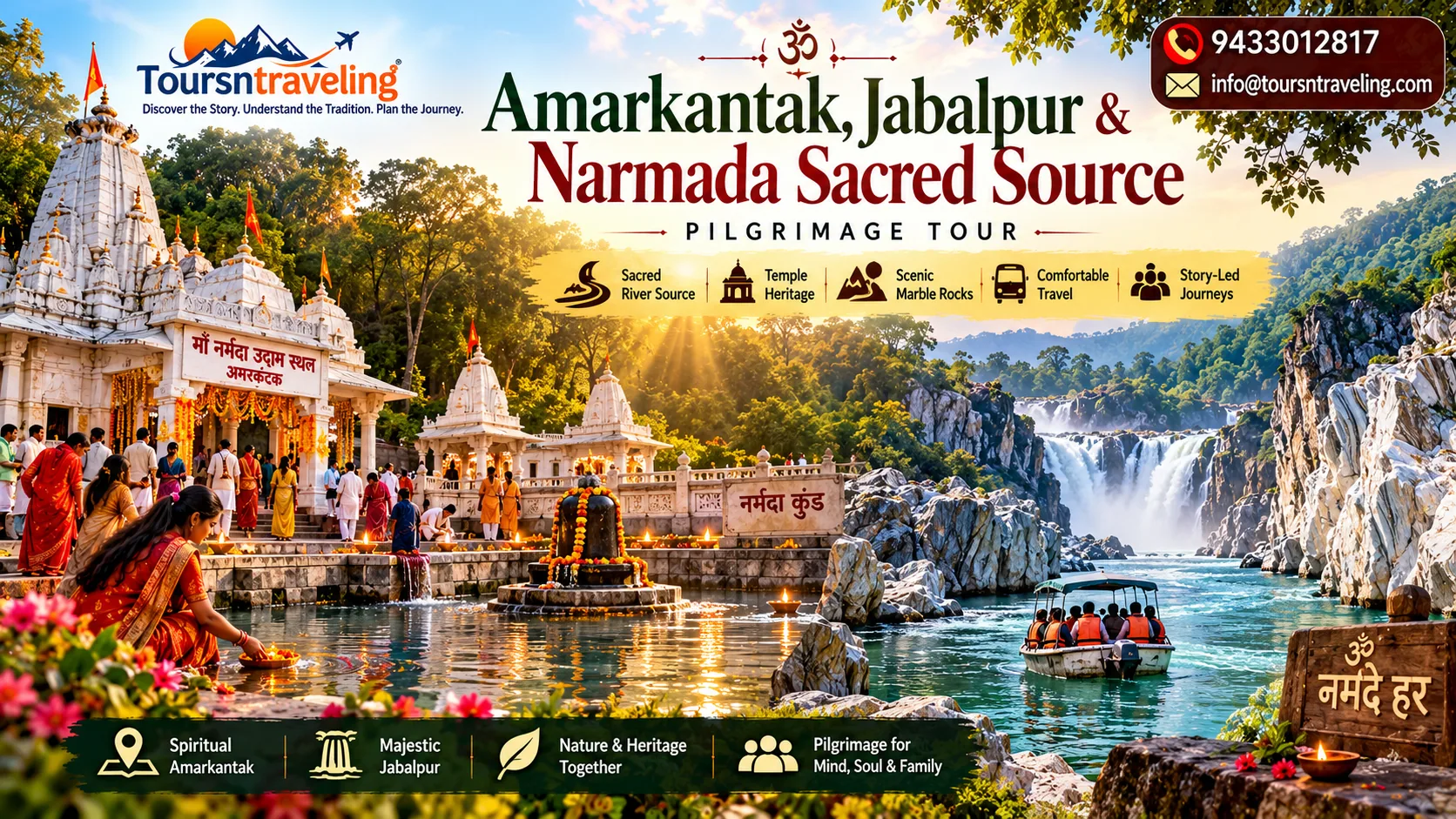
The Narmada’s sacred origin and the geological heritage of central India. A meaningful pilgrimage combining religious narratives, historical context and practical visitor awareness.
Illustrative regional visual; individual temples, hotel rooms and operating conditions must be independently confirmed.
The Narmada’s sacred origin and the geological heritage of central India. The itinerary starts from Jabalpur; changes to the route, hotel names or travel conditions require an individually dated quotation.
Pricing disclosure: The prices below are planning scenarios, not live offers, supplier quotations or ticket guarantees. Dates, party size, room type, transport and taxes can alter the final price.
Why this sacred journey matters
Amarkantak is revered as a sacred source area of the Narmada, associated with river-goddess narratives and ascetic traditions. Near Jabalpur, Bhedaghat’s marble gorge reveals a striking physical landscape alongside Narmada ritual culture.
Discover the Story — the spiritual narrative
The Narmada’s sacred origin and the geological heritage of central India. Religious stories are presented as living traditions and beliefs; they do not automatically establish historical dates or archaeological facts. At each shrine, local practice and visitor dignity take precedence over rushing to accumulate stops.
Understand the Tradition — history and culture
Amarkantak is revered as a sacred source area of the Narmada, associated with river-goddess narratives and ascetic traditions. Near Jabalpur, Bhedaghat’s marble gorge reveals a striking physical landscape alongside Narmada ritual culture. This route is designed to connect the places visited through their distinct religious communities and artistic histories, rather than presenting unrelated temples as a checklist.
Choose your pilgrimage comfort
Standard
₹13,800
Illustrative per adult, twin sharing; no hotel or vehicle inventory has been confirmed.
Clean economy / good local guesthouse category
Shared or economical AC transport allocation
Named hotels supplied after confirming dates and availability
The sequence below is practical but indicative. Daily start times and access arrangements must be reconfirmed after official booking and on the day of travel.
Day 1 — Jabalpur to Amarkantak
Travel from Jabalpur toward Amarkantak, with planned road breaks and an introduction to Narmada’s role in central Indian sacred geography.
Why this day matters: Use the first transfer to explain why the Maikal plateau and the Narmada basin matter to this route. Keep the arrival programme relaxed; an introductory walk makes more sense than fitting a long excursion after a tiring road journey.
Overnight: Amarkantak. For this route: Allow daylight for viewing carved details. A guide should explain which features belong to documented architectural history and which stories are local religious interpretations; avoid assigning precise dates to individual sculptures without an authoritative reference.
Historical and cultural interpretation: The Kalachuri-period temple complex contributes a distinct historical layer to Amarkantak beyond the more recent pilgrim facilities. Its stone architecture invites a discussion of central Indian temple forms, patronage and the long continuity of pilgrimage in the Maikal hills.
Day 2 — Narmada Udgam and temples
Visit the Narmada Udgam precinct, selected shrines and nearby accessible viewpoints. Explain origin legends separately from the physical source watershed.
Why this day matters: The Narmada source deserves time for the temple precinct as well as interpretation of river origins. Explain the devotional account of the river goddess separately from the springs and watersheds visible in the surrounding landscape.
Overnight: Amarkantak. For this route: Separate the devotional account of the river goddess from watershed geography. Visit the kund respectfully, observe any temple-specific footwear restrictions, and reserve time for the smaller shrines around the source rather than treating the site as a quick photo stop.
Historical and cultural interpretation: Amarkantak is associated with the source of the Narmada and with traditions surrounding the Son and Johila river systems. The Narmada is celebrated in regional religious literature as a sacred river; the physical spring, surrounding shrines and forested plateau are also part of a living landscape used by local communities.
Day 3 — Return toward Jabalpur
Drive back toward Jabalpur; allow an evening ghats visit when river and crowd conditions permit.
Why this day matters: If the programme includes Kapildhara or another nearby waterfall, treat it as an outdoor extension with its own walking assessment. Explain the relationship between the sacred source and its downstream river journey instead of rushing between viewpoints.
Overnight: Jabalpur. For this route: Plan boat rides as optional activities subject to water level and local restrictions. Explain the difference between a sacred river landscape and a guaranteed boating experience; allow enough travel time between the falls, ghats and the city.
Historical and cultural interpretation: Near Jabalpur, Bhedaghat places the Narmada within a dramatic gorge of marble-like rock formations. Dhuandhar Falls is another significant river landmark; local boats and viewpoints operate according to river conditions and administrative decisions.
Day 4 — Bhedaghat and departure
Visit accessible Bhedaghat viewpoints with safety guidance. Boat operations are dependent on river conditions and cannot be guaranteed; depart thereafter.
Why this day matters: At Jabalpur, allow the marble-rock river scenery and the falls to serve as the final geographic chapter of the journey. Keep boating optional and dependent on actual river conditions, then preserve adequate time for onward travel.
Overnight: Departure. Practical schedule: Confirm breakfast, travel times, temple reporting window and rest breaks daily; opening hours and queue length may change.
Interpretive focus: Your tour facilitator should explain the sacred story, distinguish documented heritage, and outline the day's customary visitor etiquette at the site.
The destinations in depth: sacred narratives, documented heritage and practical visits
A carefully interpreted pilgrimage should help visitors distinguish a sacred account from a documented historical event, and a customary ritual from a confirmed service. The following destination briefings connect the particular places on this itinerary with the questions a traveller should ask before departure. Temple rules, festival calendars and local access change; obtain current instructions from the relevant shrine or monument authority.
01 · Narmada Udgam and the meeting of sacred landscapes
Discover the Story · Understand the Tradition
Amarkantak is associated with the source of the Narmada and with traditions surrounding the Son and Johila river systems. The Narmada is celebrated in regional religious literature as a sacred river; the physical spring, surrounding shrines and forested plateau are also part of a living landscape used by local communities.
Plan the Journey — what visitors need to know
Separate the devotional account of the river goddess from watershed geography. Visit the kund respectfully, observe any temple-specific footwear restrictions, and reserve time for the smaller shrines around the source rather than treating the site as a quick photo stop.
02 · Ancient temples of Amarkantak
Discover the Story · Understand the Tradition
The Kalachuri-period temple complex contributes a distinct historical layer to Amarkantak beyond the more recent pilgrim facilities. Its stone architecture invites a discussion of central Indian temple forms, patronage and the long continuity of pilgrimage in the Maikal hills.
Plan the Journey — what visitors need to know
Allow daylight for viewing carved details. A guide should explain which features belong to documented architectural history and which stories are local religious interpretations; avoid assigning precise dates to individual sculptures without an authoritative reference.
03 · Kapildhara and the river landscape
Discover the Story · Understand the Tradition
Kapildhara is valued for its waterfall scenery and associations with the sage Kapila in local tradition. The terrain changes quickly between roads, stairs, rocky viewpoints and seasonal water flows; a waterfall visit is a nature excursion, not an assured ritual opportunity.
Plan the Journey — what visitors need to know
Confirm the actual walking route and weather before taking older guests. Viewpoints and steps may be slippery during rain. Visitors should not assume that the waterfall can safely be approached or entered.
04 · Jabalpur and the marble-rock gorge
Discover the Story · Understand the Tradition
Near Jabalpur, Bhedaghat places the Narmada within a dramatic gorge of marble-like rock formations. Dhuandhar Falls is another significant river landmark; local boats and viewpoints operate according to river conditions and administrative decisions.
Plan the Journey — what visitors need to know
Plan boat rides as optional activities subject to water level and local restrictions. Explain the difference between a sacred river landscape and a guaranteed boating experience; allow enough travel time between the falls, ghats and the city.
Sacred stories, visitor rules and respectful procedures
What must be confirmed before the visit
Waterfalls, ghats, boating and rural roads require seasonal safety checks; do not promise boat rides during unsuitable river flows.
Use the individual temple/trust or government authority for the latest darshan rules, admission, dress, photography, footwear and permitted offerings.
Carry acceptable photo identification, booking confirmations and any required permits. Separate ritual or priority darshan is not included unless written into your quote.
Have an accessible alternative for steep steps, long parikrama, crowded ceremonies or strenuous hill travel.
Do not assume private guides can authorize restricted entry or sell official tickets.
Locally produced tribal paintings, handwoven textiles, bamboo crafts and responsibly sourced herbal products. Shopping is entirely optional and should follow the main worship programme, never replace scheduled darshan. Avoid pressured sales and purchases of restricted religious or wildlife materials.
Accommodation choices and transparent indicative costs
Accommodation is planned at these overnight bases (not booked):
Amarkantak: Standard—clean licensed budget room; Deluxe—well-reviewed mid-range AC hotel; Premium—best suitable upscale property where available. No named property is reserved.
Jabalpur: Standard—clean licensed budget room; Deluxe—well-reviewed mid-range AC hotel; Premium—best suitable upscale property where available. No named property is reserved.
Illustrative per-person budget component
Standard
Deluxe
Premium
Accommodation
₹4,400
₹6,700
₹10,200
Ground transport
₹4,300
₹6,500
₹9,900
Meals / refreshment allowance
₹2,100
₹3,100
₹4,800
Local coordination and guide allowance
₹1,200
₹1,900
₹2,900
Contingency & operating margin
₹1,800
₹2,700
₹4,000
Total illustrative price / adult
₹13,800
₹20,900
₹31,800
Costs are illustrative allocations, calculated for comparison rather than based on hotel or vehicle quotations. Personal expenditure, major arrival/departure tickets, paid temple rituals and exceptional entry or transport fees are outside this estimate unless explicitly included in a signed proposal.
Included in planning assumption
Overnight accommodation on twin sharing, a practical road itinerary and local coordination provision. Meals and refreshments are an allowance, not a guaranteed fixed menu or unrestricted meal plan. Names of properties and vehicle specifications must be provided in the final written quotation.
Not automatically included
Flights or trains from the traveller’s home city; specific special darshan or puja bookings; optional hill transports and ferry or ropeway tickets; porter and personal assistance; extra nights due to weather; shopping or personal expenses.
How to choose the right travel category for this particular route
The figures published on this page are indicative per-person land-arrangement estimates, not live hotel quotations or tickets already reserved. Travel dates, room-sharing arrangements, group size and the actual overnight bases must all be confirmed. The comparison below describes what to ask for when choosing among the three categories; no supplier is contracted by virtue of appearing in a planning example.
Standard — planning estimate ₹13,800
The existing standard allowance describes the intended comfort level for this route, not a promise of a particular property. The package currently identifies these planning features: Clean economy / good local guesthouse category; Shared or economical AC transport allocation; Named hotels supplied after confirming dates and availability. For comparison only, the overnight-location register lists Amarkantak: MPT Holiday Homes Amarkantak; Jabalpur: Hotel Samdareeya. Before payment, obtain a dated quote identifying each overnight hotel, exact room category, meal plan, vehicle and pickup point. If the best available accommodation at a smaller stop falls below the advertised tier, request a clear alternative or price adjustment instead of assuming an upgrade is guaranteed.
Deluxe — planning estimate ₹20,900
The existing deluxe allowance describes the intended comfort level for this route, not a promise of a particular property. The package currently identifies these planning features: Mid-range hotels with upgraded room amenities; Private AC vehicle allocation; Named hotels supplied after confirming dates and availability. For comparison only, the overnight-location register lists Amarkantak: MPT Holiday Homes Amarkantak; Jabalpur: Narmada Jacksons. Before payment, obtain a dated quote identifying each overnight hotel, exact room category, meal plan, vehicle and pickup point. If the best available accommodation at a smaller stop falls below the advertised tier, request a clear alternative or price adjustment instead of assuming an upgrade is guaranteed.
Premium — planning estimate ₹31,800
The existing premium allowance describes the intended comfort level for this route, not a promise of a particular property. The package currently identifies these planning features: Higher-category stays in major cities; best-available local category elsewhere; Enhanced private AC vehicle allocation; Named hotels supplied after confirming dates and availability. For comparison only, the overnight-location register lists Amarkantak: MPT Holiday Homes Amarkantak; Jabalpur: Vijan Mahal. Before payment, obtain a dated quote identifying each overnight hotel, exact room category, meal plan, vehicle and pickup point. If the best available accommodation at a smaller stop falls below the advertised tier, request a clear alternative or price adjustment instead of assuming an upgrade is guaranteed.
Before departure: destination-by-destination decisions
A date-specific quotation should identify the named hotels, the route actually being operated, meal inclusions, vehicle category, expected walking effort and any separate ritual or attraction charges. The following checks are specific to the places described in this tour and should be resolved before the payment or booking deadline.
Narmada Udgam and the meeting of sacred landscapes: Separate the devotional account of the river goddess from watershed geography. Visit the kund respectfully, observe any temple-specific footwear restrictions, and reserve time for the smaller shrines around the source rather than treating the site as a quick photo stop.
Ancient temples of Amarkantak: Allow daylight for viewing carved details. A guide should explain which features belong to documented architectural history and which stories are local religious interpretations; avoid assigning precise dates to individual sculptures without an authoritative reference.
Kapildhara and the river landscape: Confirm the actual walking route and weather before taking older guests. Viewpoints and steps may be slippery during rain. Visitors should not assume that the waterfall can safely be approached or entered.
Jabalpur and the marble-rock gorge: Plan boat rides as optional activities subject to water level and local restrictions. Explain the difference between a sacred river landscape and a guaranteed boating experience; allow enough travel time between the falls, ghats and the city.
Departure checklist
Confirm individual travelling dates, passenger count, room sharing, age profile and any mobility needs.
Check the latest current temple opening/closure schedule, pilgrim registration and dress rules with official authorities.
Review written hotel examples, cancellation and refund terms, vehicle specifications and exactly which meals are included.
Allow contingency for crowds, delays, weather or strenuous travel; do not promise a fixed darshan completion hour.
Reconfirm identity documents, permits, local cash needs and appropriate footwear.
Planning examples only: properties are not booked, contracted or guaranteed. Category assignments are preliminary, NOT certified hotel star ratings. Please confirm operating status, room type, security, parking, lift or ground-floor access, meal plan, actual route and room tariff before publishing a dated quotation.
Planned night halt
Standard: example
Deluxe: example
Premium: example
Verification / caution
Amarkantak
MPT Holiday Homes Amarkantak
MPT Holiday Homes Amarkantak
MPT Holiday Homes Amarkantak
Check category suitability, parking, lift, safety and distance to shrine. Public accommodation directory available.
Jabalpur
Hotel Samdareeya
Narmada Jacksons
Vijan Mahal
Check category suitability, parking, lift, safety and distance to shrine. Property identity and availability require independent confirmation.
Hotel examples are not included by name in the indicative package prices above. Property changes can affect cost; obtain supplier quotes before selling. If a candidate does not meet the stated category, substitute a verified equivalent and disclose it clearly.